
Guides · Parks
How to shoot the parks
A public Orlando park is a lighting problem, a wind problem, a condensation problem, then a paper problem. Noon is a hard overhead key. Water throws glare and a breeze that eats foam. The walk from the car’s air-conditioning to the lake fogs a cold body. Handheld craft on a Lake Eola sidewalk or at Bill Frederick is legal only to the degree the land manager’s film page still says it is. Fees live on those pages the day you look.
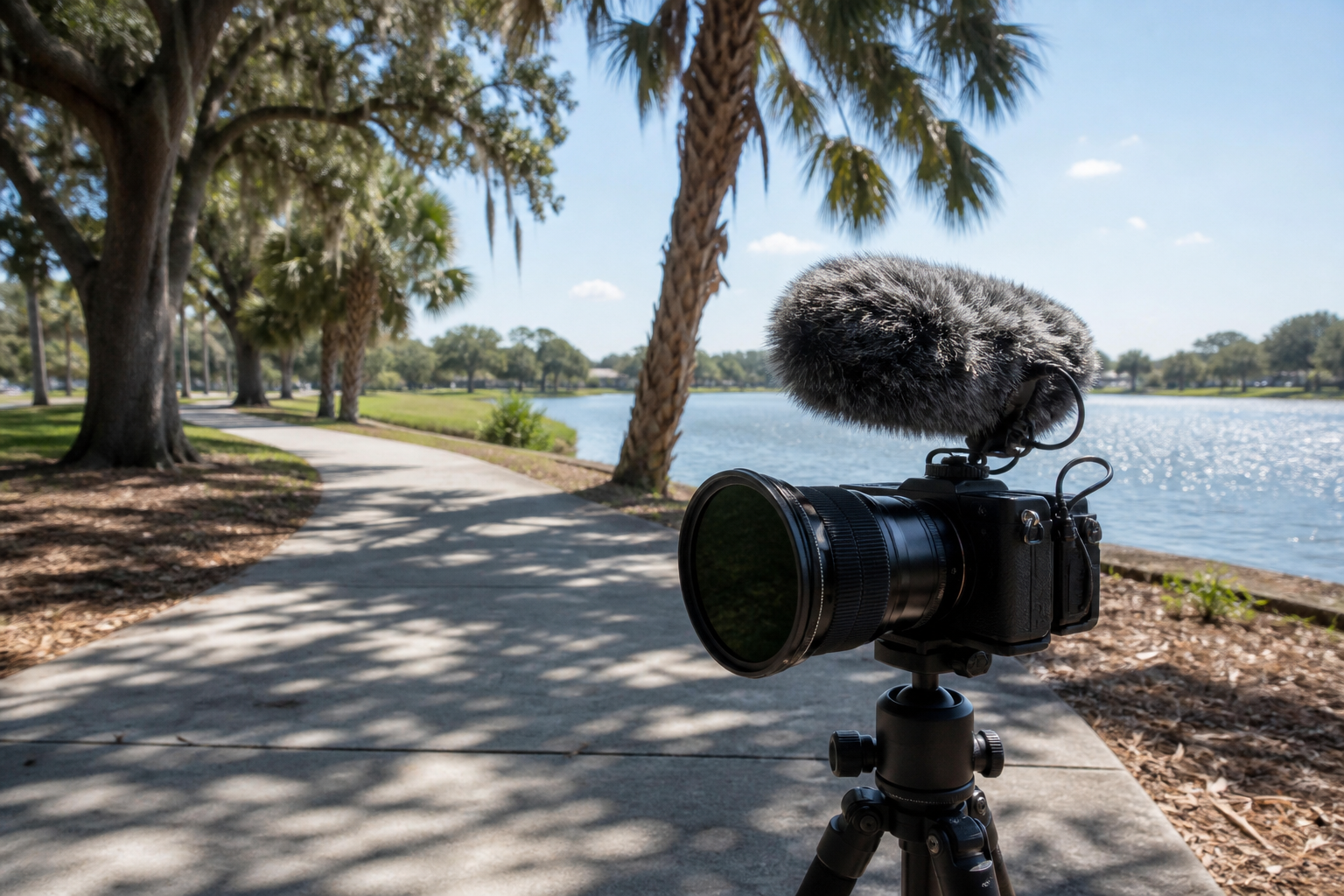
Florida noon as the key
Outdoors at solar noon the sun is the key whether the sidewalk is downtown or under oaks. Faces go skull-shadow. Pavement speculates. At 24 frames per second a 180-degree shutter is 1/48 of a second — 1/50 on some bodies. That is the motion look of video. Florida noon will try to push the shutter faster unless density is already on the lens. White balance at 5600 K unless the stand-up is under tungsten, which is a different family. A small daylight LED is fill, not a replacement for that sky. Photometrics for a 60-watt daylight head live on the craft lesson.
Two public parks, two craft geometries, same sun. A Lake Eola sidewalk is a loop of hardscape and open water: glare, bounce off concrete, little canopy at the fountain. Bill Frederick (Turkey Lake) gives more oak shade in the openings, then a wider fetch of wind on the lake. Neither is a pin on a secret map. Both are how noon and water behave on city property. Hours, tents, and drones stay on the city’s live pages.
Polarizer versus ND
They are not the same glass. A circular polarizer kills polarized glare — the sheen on Turkey Lake, the fountain, wet leaves, a windshield. Rotate it until the water goes dark enough to read. It costs about one to two stops. It does not hold a 1/48 shutter by itself under a July sky.
A neutral-density filter is smoked glass: it cuts all wavelengths so the iris can stay where the face still has shape. A variable ND is two polarizing elements stacked. At the dense end it can vignette and show an X. For Florida noon, a modest range — or a solid ND matched to the stop you already want — is cleaner than cranking a variable to black. Confirm the thread on the lens you already own; 67 mm is a common video-kit size, not a universal one.
| Circular polarizer | Neutral density | |
|---|---|---|
| What it cuts | Polarized glare on water, sky, leaves | Overall illuminance, all directions |
| Park job | Lake surface that still reads as water | 1/48 (or 1/50) under noon |
| Cost in stops | About 1–2, plus the rotation you choose | Whatever the mark says; variable ND is a range |
| Stack | Polarizer first if both go on | ND for shutter; do not treat a polarizer as ND |
| Search | Get this | Get this |
A polarizer darkens the lake. ND holds the shutter. Mixing the names is how a noon take still clips.
Stream Orlando, park craft
Wind that comes off the water
A lake path has a breeze even when the oaks are still. A shotgun with foam only is still naked. Foam is an indoor plosive cap. Fur goes on next — a dead-cat windshield over the capsule. Then move the mic out of the gust: under a shirt as a lav, off-axis to the fetch, or a step back from the waterline. A high-pass is last, after the rumble is still wind and not a truck. RØDE’s DeadCat copy is built for “windy recording environments”; the audio lesson cites that page.
On a Lake Eola sidewalk the gust is often along the loop. At Bill Frederick the fetch across Turkey Lake is longer. Same order either place: fur, position, then filter. Get this fur. A camera-shoe shotgun still wants a shock mount that stays put when you walk. Get this. RØDE VideoMic GO II is one camera-mount search if the shoe is already empty. Get this.
The AC-to-lake walk
Sony’s interchangeable-lens precautions put a designed operating window at 0°C to 40°C (32°F to 104°F) and warn against a car parked in the sun. The same family’s condensation help: moisture may form “when you bring the unit from an air conditioned car or room into a hot place outside.” Seal the body until it reaches ambient. About an hour in their wording if condensation has already formed. Then take the cap off.
The park is that hot place. Bag the camera in the car, walk to the sidewalk, wait, then open. Afternoon rain is a cover, not a towel. Get this. A compact travel tripod keeps an outro still when the wind is already on the mic; a tripod on city hardscape is also a paper question. Get this.
Sources: Sony Help Guide, Precautions; Sony, On moisture condensation.
Paper before the encoder
A live take on city property is a land-manager question. Open the City of Orlando’s Office of Special Events page — the city door that names film productions among permitted work on city property. The Florida Film Commission (floridafilm.com) is the statewide contact for notice windows and production paper. Confirm fees, insurance, and drone rules on those pages the day you look. This lesson names the doors. It invents no dollar amount.
Handheld walking video on a public sidewalk and a crew with stands, a pop-up, and a product table are different jobs. Tents, drones, and blocking hardscape leave the casual-walk lane. The longer literacy — park hours, the 100-person event line, Film Commission notice windows — sits on places to film. A pin you cannot cite as permitted does not belong on a public page.
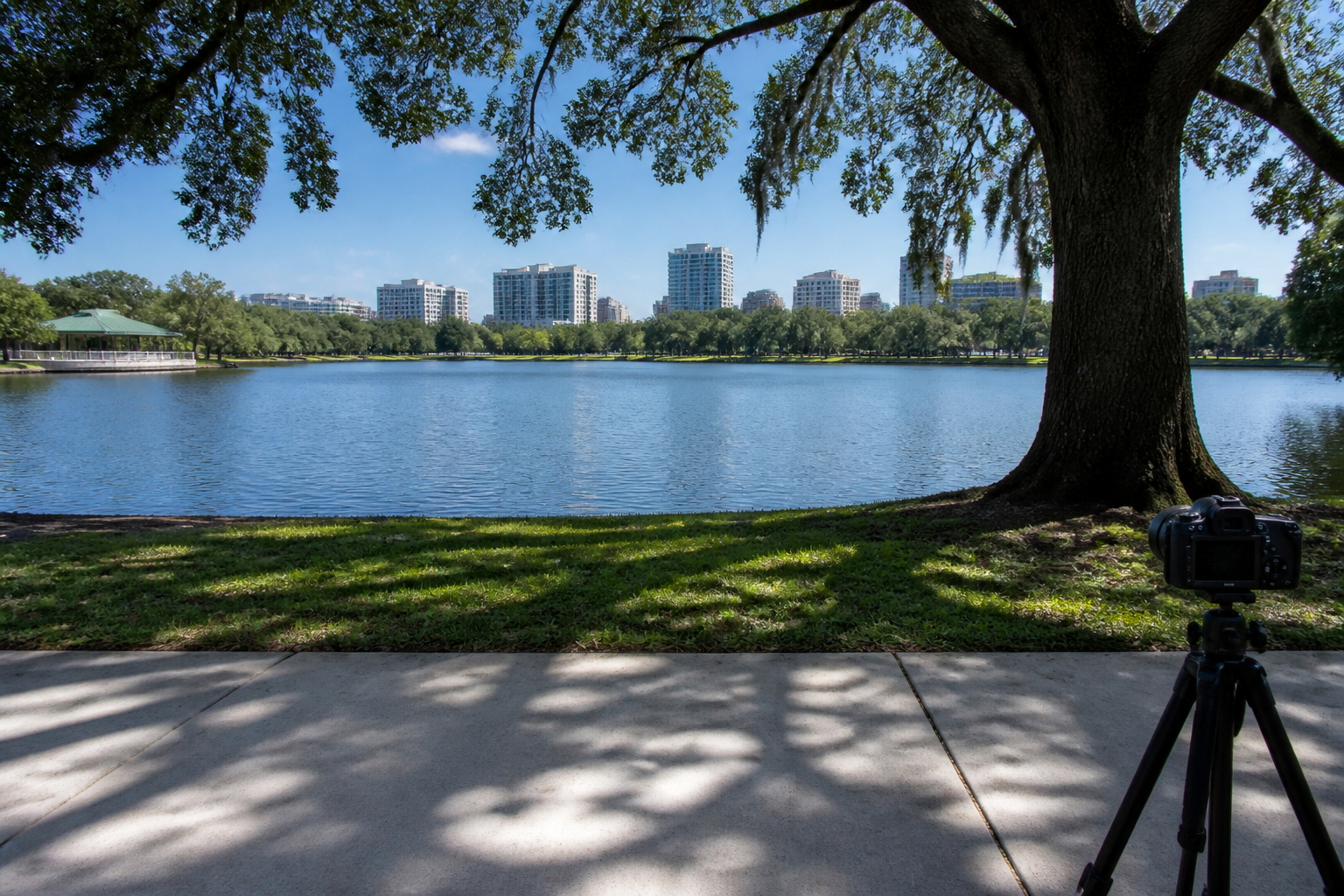
A working order
-
Read the two film pages
City of Orlando special-events / film door, then floridafilm.com. Count bodies, stands, and structures. If the take needs a tent, a drone, or a crowd, stop and write the land manager.
-
Bag the body in the car
AC to lake is a condensation event. Wait until the kit is ambient. Shade the bag; the dash is storage Sony warns against.
-
Fur, then polarizer, then ND
Wind first so the voice survives. Polarizer until the water reads. ND until 1/48 holds. 5600 K. A clap at talking distance is the audio check.
-
Stand where the public still walks
Do not own the sidewalk. Open shade if the face is a skull. Fill is bounce or a small daylight LED, not a second sun.
-
Encode last
YouTube Help’s live table wants CBR and a two-second keyframe. The pipe is a separate lesson on uplink. Rain cover on before the afternoon build.
FAQ
- What does a City of Orlando film permit cost?
- Read the live city special-events page and floridafilm.com. Fees change. No number here is a quote.
- Polarizer on the lake, ND on the face?
- Polarizer for glare on water. ND for the shutter. Stack polarizer first if both go on. A variable ND at max is not a polarizer substitute.
- Lake Eola or Bill Frederick?
- Both are public parks with noon, wind, and condensation. The sidewalk is harder sun and harder glare. Turkey Lake is more canopy and a longer fetch. Paper is the same two doors.